Historical Contextualization of the Italian American Experience: 2021 Essay and Interview
The Italian American Experience in California
The life of Italian Americans within the United States differed dramatically depending on the region and era in which they lived. Historically, experiences for Italian Americans on the coast of California were better than those who lived on the East Coast or in the South. However, Italian Americans on the West Coast still faced racial biases, discrimination, and hardships because of their race/ethnicity. These issues were especially prevalent in California during World War II. Discrimination against Italian Americans throughout California, specifically in Santa Cruz, was heightened in the time leading up to World War II, throughout the war, and continued after the war’s conclusion. In this essay, I will focus primarily on the experiences of my family and other Italian Americans in Santa Cruz.
Many Italians immigrated to the West Coast, primarily to San Francisco, in search of new opportunities, and with the intention of beginning a new life with greater opportunities. While there were achievable opportunities for immigrants in California, Italian Americans were exploited for work and continued to face discrimination, as many of them did not speak English. Moreover, many Americans disliked Italians within the United States because of their “high rate of repatriation,” in which they sent the money they earned to their family in Italy (Laurino 83).
In an interview conducted in 2005 of my Nonno [grandfather], Giovanni (John) Colombini, and my great uncle, Zio Osvaldo (Jimmy) Colombini, they briefly illustrate their personal immigration experiences from Italy to America. Additionally, they discuss their lives once they settled in America, their experiences in World War II, and their life after war’s end.
John immigrated to the United States through Ellis Island in 1936, as did Jimmy in 1938. Once in America, each brother completed their journey by train to San Francisco where they later found work. In San Francisco, John first worked for Petri Wine Company. When Jimmy first found a job in San Francisco, he worked as a manufacturer/salesperson at Lucca Ravioli. Just as Laurino introduces the notion of repatriation, John and Jimmy sent portions of the money they made to their parents and family in Italy. As children growing up in Italy, they realized their family faced many hardships. While their parents did their best to provide for their three children, they made little money, especially when my great-grandfather left to fight in World War I. The ideal of the American Dream and the goal of achieving a more prosperous life encouraged these two brothers to leave their home country and their family for a chance at success.
Like many Italian immigrants to the United States, John and Jimmy were drafted into World War II following their arrival. In America, the importance of heritage and allegiance was questioned by Americans and the government amongst rising tensions between the United States and Italy. Upon settling in America, many Italian immigrants believed that “one’s heritage might be Italian, but one’s allegiance was to America” (Laurino 173). No matter the racial biases and discrimination Italian Americans experienced in the country, they were expected to wholeheartedly support the United States’ war effort. John was drafted to the United States Army as a paratrooper in Okinawa, Japan in 1943. He arrived in Nagasaki by boat in 1945, one day before the atomic bomb was dropped. Similarly, Jimmy was drafted into the military in 1943, and was stationed in the German arena. In Germany, Jimmy worked on an ambulance treating and transferring wounded soldiers to hospitals. Neither brother spoke great English when they were drafted, but in the interview Jimmy states that he learned “as much as I know now. I didn’t go to school for improving.” Just as many Italian American men, John and Jimmy were given their American citizenship after their time in service, at war’s end in 1945. This experience was represented in the documentary, Prisoners In Paradise, in which war veterans gained their citizenship through participating in the war. Many of the Italian immigrant soldiers documented in this film had similar experiences to my Nonno and Zio. Additionally, Laurino wrote that following the war, “Italian American identity felt more tangible than ever” (Laurino 180). This could be attributed to the common cause that Italian immigrants and American soldiers joined in an effort to represent, and to defend the United States.
However, life for Italian Americans during World War II was difficult for Italian Americans, especially along the California coast. Within the United States during wartime, Italian Americans were deemed enemy aliens and subjected to restrictions. In Santa Cruz, California, fishing was a major industry, and many fishermen were Italian. At the beginning of World War II, after President Theodore Roosevelt issued Proclamation 2527 declaring Italian Americans enemy aliens, many Santa Cruz fishermen, including Steve Ghio, who had sons fighting in the war, were banned from the wharf (Dunn 84). The Santa Cruz Sentinel published an article which stated, “Fishermen with 23 Sons in Army and Navy Are Bound to Wharf While Boats Lie Idle and Sea Food is Needed” (Dunn 84).
Other prominent Santa Cruz Italian American families and businesses were severely impacted by World War II restrictions. The Stagnaro family, today, and then, a well-known fishing family in Santa Cruz, were among many who were personally affected by these proclamations. Celestina Stagnaro Loero, a seventy-six year old woman at the time of these restrictions, who had lived for forty-one years in her Santa Cruz home was forced to relocate inland within forty eight hours (Signore 213). Similarly, Gervasio Comelli was deemed an enemy alien, and due to restrictions, could no longer access or work on his Highway 1 farm in Santa Cruz. These experiences illustrate the personal impact on Italian Americans in coastal California cities, as well as the negative effects on the United States economy as a result of the restrictions which inhibited many workers’ ability to complete their jobs, and to earn a living wage (Signore 215).
After World War II’s end, there were still many prejudices against Italian Americans along the West Coast, but assimilation was more prominent. Signore wrote, “the issue of language has had perhaps the most significant and long-lasting effect on postwar Italian American identity” (Signore 221). I asked my mother, Sandra Colombini (married name, Locatelli), about her memories of her father, John’s experiences in Santa Cruz, and about her personal experiences of living in Santa Cruz as an Italian American. She documented her experiences in Italian, her first language, of which we shared with her parents, and of which she continues to treasure today. First, I asked her about her father’s life in Santa Cruz when she was young. She began by stating, “Mio padre preferiva parlare in Italiano. Si vergognava parlare in inglese perché aveva paura di sbagliare. In più, aveva paura che gli americani non lo potevano capire. Babbo, allora, si fidava in mia mamma per fare le telefonate, oppure rispondere per lui.” (“My father preferred to speak in Italian. He was embarrassed to speak in English because he was afraid to make mistakes. Moreover, he was scared Americans would not understand him. My dad, therefore, depended on my mom [who spoke great English] to make phone calls, otherwise respond on his behalf.”)
My mother continued to share memories of her father’s daily life, “Mio padre era molto contento quando ogni mattina incontrava gli altri immigranti italiani. Tutti parlavano delle loro esperienze, dando gli altri idee, consigli, o nomi di persone che potevano aiutare nelle cose quotidiane. I miei genitori erano membri di molti club Italo-Americani dove erano invitati, dove potevano sentirsi ad agio, e dove tenevano la nostalgia dell’Italia.” (“My father was very happy every morning when he met with other Italian immigrants. They all spoke of their experiences, giving one another ideas, advice, or names of people who could help with their daily needs. My parents were members of many Italian American clubs where they were invited, where they were welcomed and comfortable, and where they had nostalgia for Italy.”) My mom recalled my Nonna’s desire and proposal to go on a cruise with her husband, but my Nonno invariably responded by saying, “sono andato in due crociere: la prima-quando sono venuto in America, e la seconda-quando sono andato in Giappone per la guerra. Basta!” (“I went on two cruises: the first-when I came to America, and the second-when I went to Japan for the war. Enough!”)
Besides enjoying life with fellow Italians, Nonno also loved farming alongside farmers of diverse backgrounds along the California coast. In a Santa Cruz Sentinel article titled “Farming in the Alternative,” my Nonno was celebrated along with another “ethnic” farmer, Johnathon Steinburg. The article states that Steinburg’s hero, “John Colombini, an Italian immigrant who has farmed the North Coast for 40-plus years” was a part of the diversity he loved in the farming community of Santa Cruz (Schilling). Though my Nonno and other Italian Americans faced adversity in farming, the successful industry and community they were a part of was fortunate to prosper.
I additionally asked my mother about her perspective and experiences of being an Italian American in Santa Cruz. She recalled her youth, “Frequentavo la scuola parrocchiale con altri ragazzi come me. Nel tempo libero, andavo con la mia famiglia alle feste con altri Italo-Americani. La mia famiglia non aveva tanti soldi quando ero giovane però eravamo orgogliosi della nostra eredità Italiana.” (I went to parochial school with kids like me [kids of immigrants who were working class citizens]. In my free time, I went with my family to parties with other Italian Americans. My family did not have much money when I was young, but we were proud of our Italian heritage.”)
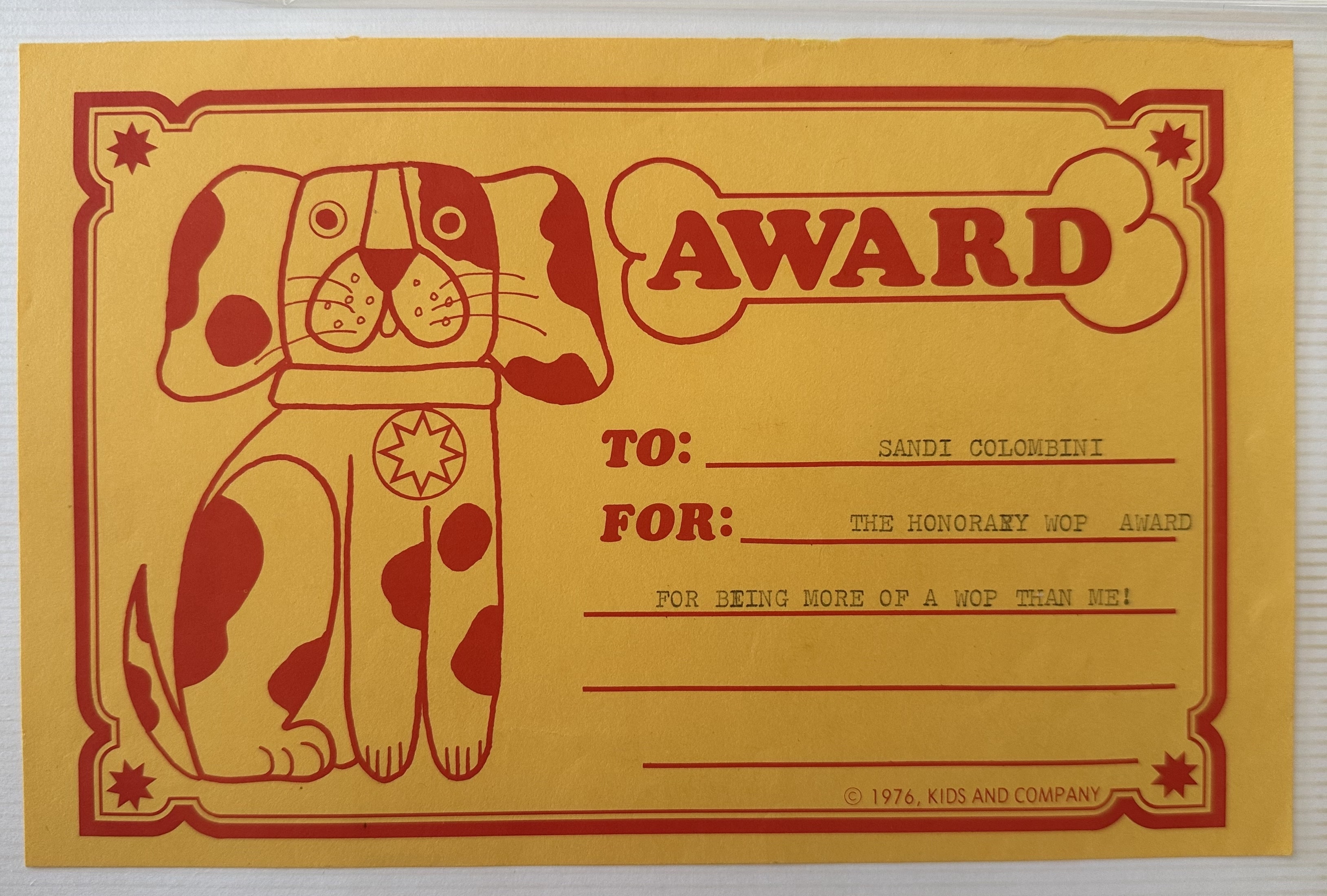
While looking at family photo albums and discussing this topic with my mom, I came across an award she was given in high school (in the early 1980s) entitled, “Honorary WOP Award” (image included below). I asked my mom about this “award,” and why she was the one to receive it. She responded, “Non so perché. Perché non usavano la parola “DAGO” in quei tempi?” (I don’t know why. Because they did not use the term “DAGO” at that time?”). While my mom never thought much of this, I found this staggering because a term that was historically used derogatorily to put Italian Americans down was continued to be used generations later. During World War II, kids in schoolyards especially called Italian American students these belittling terms as a result of heightened discrimination due to wartime fears and racial tensions (Laurino 173). In the time my mom grew up and lived in Santa Cruz, being Italian American was something to be proud of, but there were still instances like this where historically derogatory terms “playfully” resurfaced at the expense of undeserving people.
I concluded my discussion with my mom by asking her thoughts on my decision to major in Italian Studies and explore to further my Italian heritage. She responded by saying, “Anch’io ho voluto sapere di più della nostra storia perché gli Italo-Americani avevano un passato molto importante ed interessante. Mi fa molto piacere, e farebbe molto orgoglioso i tuoi nonni perché è importante sapere e conoscere i tuoi radici.” (“I also wanted to know about our history because Italian Americans had an important and interesting past. I am very happy, and your grandparents would be pleased for you to know and understand your roots.”)
Italian Americans contributed greatly to California’s history following their immigration to, and settlement in the United States. While racial prejudices and discrimination were prevalent, prominently during World War II, many Italian Americans in California were ambitious to start a better life. My grandparents were examples of immigrants who recognized the possibility of achieving the American dream, and despite the hardships and the sacrifices they endured in leaving Italy, they never regretted their decision to immigrate to America. Despite the injustices Italian Americans faced in Santa Cruz historically, today we celebrate our heritage and their legacy.