The Interesting Narrative of the Life of Olaudah Equiano
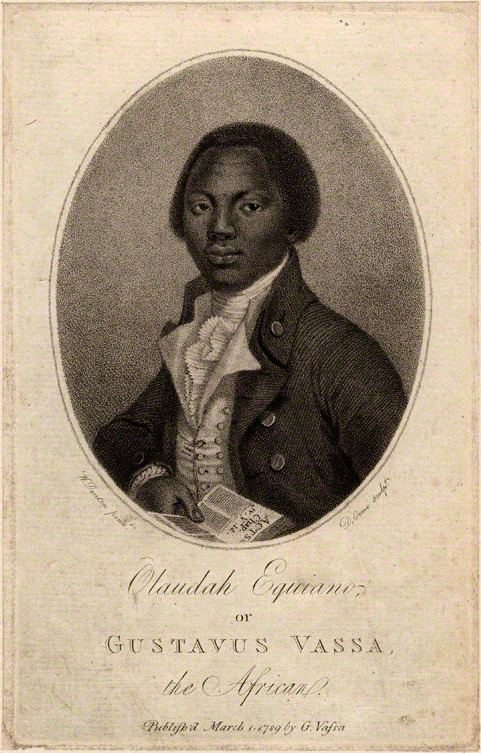
The Interesting Narrative of the Life of Olaudah Equiano, in autoethnographic fashion, acknowledges and directly confronts the racist stereotypes discussed on the previous page. These stereotypes were ones that were commonly held by Equiano’s primary audience: British, European citizens.
One way Equiano does this is by acquainting his British readers with the richness of life and culture of his African home, writing “The part of Africa, known by the name of Guinea, to which the trade of slaves is carried on, extends along the coast above 34,000 miles, from the Senegal to Angola, and includes a variety of kingdoms. Of these the most considerable is the kingdom of Benin, both as to extent and wealth, the richness and cultivation of the soil, the power of its king, and the number and warlike disposition of the inhabitants” (Equiano 46). He goes on to detail dances, rites, and other social customs of his village, highlighting the social complexity of African society, and endeavoring to directly contradict presumptions held by British citizens that African society was “backwards” and “barbaric” compared to their own distinguished, “civilized” British society.
It is an attempt by Equiano to combat the racist stereotypes of Africans as an inferior people, as well as an attempt to reverse the homogenization of beautifully diverse African cultures. As Tommy Orange does in his novel, There, There, Equiano uses such detailed, cultural and societal descriptions to humanize Africans in the eyes of his British audience, transforming what Europeans, at the time, perceived to be a “beastial” society only worthy of enslavement, into a complex society, and one not altogether different from society in Britain.
Equiano continues to confront harmful stereotypes of African people later on in the narrative. One moment in which he does this takes place when he is first aboard the slave ship crossing the Middle Passage and briefly discusses his fear of white people. Equiano writes, “...and I was not persuaded that I had gotten into a world of bad spirits, and that they were going to kill me. Their complexions too differing so much from ours, their long hair, and the language they spoke, (which was very different from any I had ever heard) united to confirm me in this belief…I asked [some black people about me] if we were not to be eaten by those white men with horrible looks, red faces, and long hair” (Equiano 70). This quote highlights the natural tendency of humans to fear the known, and is a moment, which I believe Equiano includes strategically in his narrative to again, humanize Africans in the eyes of Europeans. It serves to put into perspective for his British audience the terror and uncertainty that enslaved Africans endured at the hands of foreigners, painting Africans in a more sympathetic light.