Anti-Chinese Policies
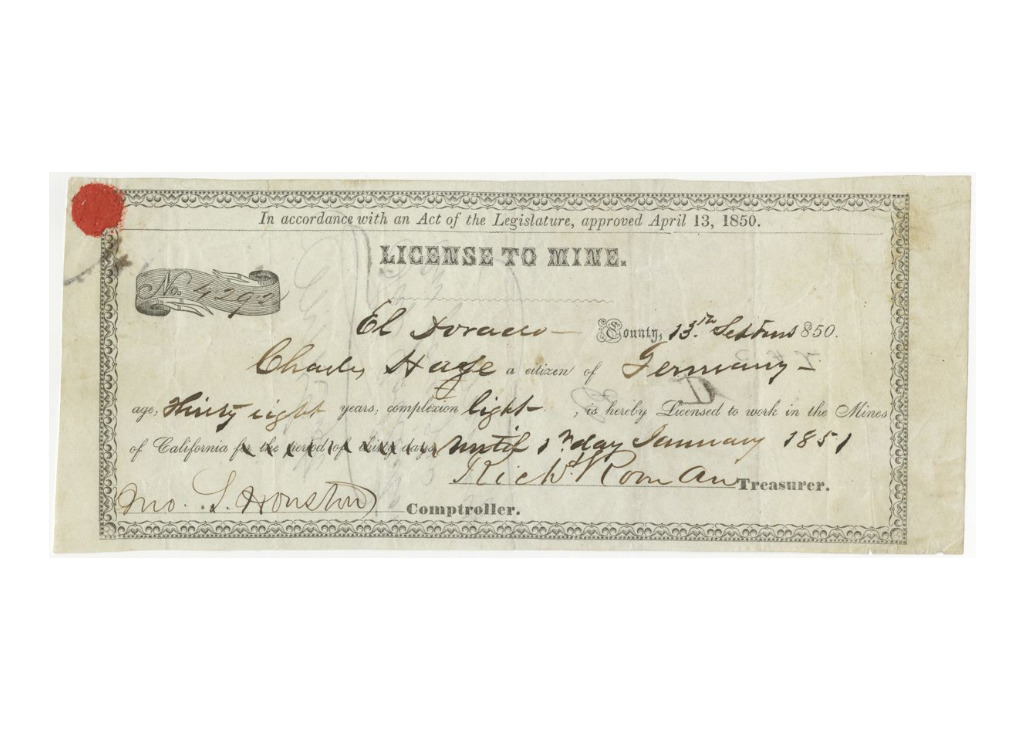
Foreign Miners’ Tax Act (1850)
In 1850, the California state legislature enacted the Foreign Miners’ Tax which was aimed to exert greater control over all the foreign miners within the state and also to raise revenues that were badly needed for the state treasury. With this policy, foreign miners were required to obtain a gold mining license for $20 per month. Some historians believe the true aim of this act was to drive away foreign miners from mining regions. This mostly targeted Chinese immigrants because they were one of the larger populations that made up foreign miners. This tax set a big financial burden on Chinese immigrants because they were already having financial difficulty with necessities and working in harsh conditions all whilst being paid very little.
Due to California’s newness to the union, they lacked the proper resources to enforce this foreign miners’ tax. Therefore, they repealed the Foreign Miners Tax Act into the Foreign Miners’ License Tax Act of 1852, which changed the monthly fee to $3. A year later, it would raise to $4 per month. Amidst all this change, Chinese immigrants remained a target because they were seen as an important source of state revenue for the financial stability of California and its counties. The tax marginalized Chinese immigrants and reduced their large presence in the state’s economy. The foreign miners’ tax was only one way Chinese immigrants were discriminated against.
Commutation Tax (1852-1853) and Capitation Tax (1855)
Commutation tax and capitation tax were two other California financial policies that were anti-Chinese. In 1852 and 1853, California enacted a commutation tax that required incoming foreign ships to post a $500 bond for every foreign passenger onboard. There was also an option to post the bond using payments from $5 to $50 per passenger instead. Then, in 1855 California passed a capitation tax where arriving vessels were taxed $50 per person who was unable to become a citizen. This clearly targeted Chinese immigrants because they were unable to become American citizens because they were not white. Once again, these taxes were disguised as means of increasing the state’s revenue even though they strategically excluded Chinese immigrants from California’s society. However, these policies were slightly different because they targeted Chinese immigrants at the point of entry into the state, effectively restricting the number of Chinese immigrants who could come to California. These taxes created an environment where Chinese immigrants were marginalized, while perpetuating a sense of racial superiority among white settlers.