Impact of Mussolini and International Influences
During World War II, Italian Americans struggled to balance their connections to both America and Italy. When Mussolini rose to power, he created sharp divisions within Italian American communities. Some Italian Americans initially supported him, impressed by his early work improving Italy's infrastructure and international standing. However, as Mussolini grew closer to Nazi Germany, many Italian Americans became increasingly uncomfortable with his leadership, especially those who held public positions or had previously expressed support for his policies.
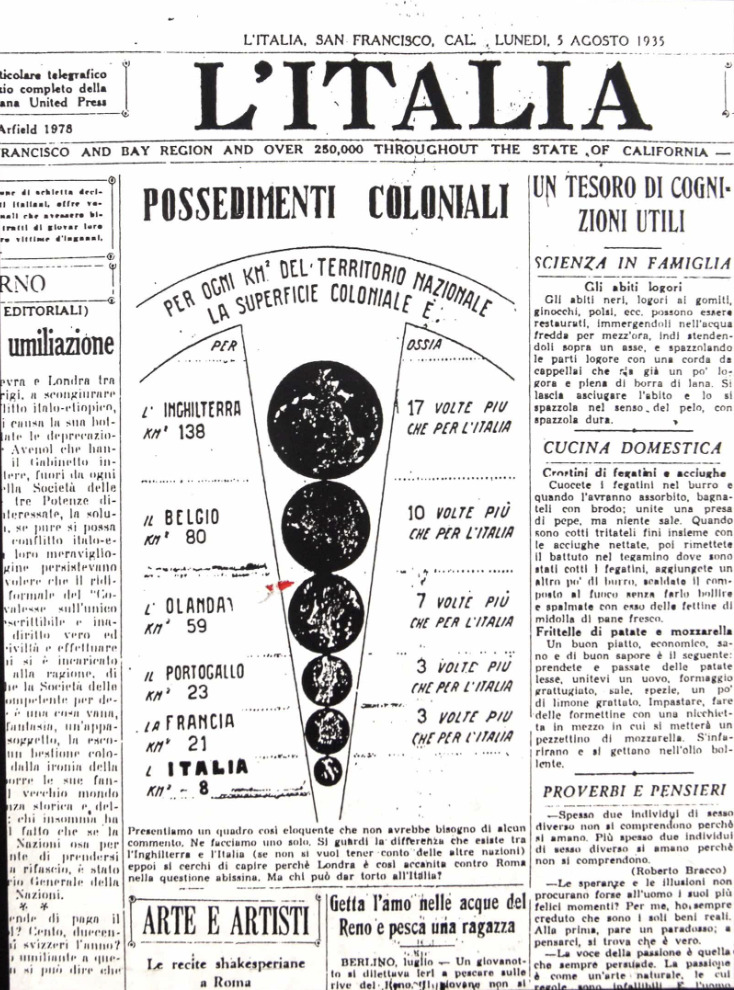
Italian language newspapers in America, particularly L'Italia, often published pro-Mussolini content. For example, when Italy invaded Ethiopia in 1935, L'Italia defended the action by pointing out that Italy had fewer colonies than other European nations (Blakemore). These newspapers tried to build pride among Italian Americans in their heritage. However, as Italy became more closely tied to Nazi Germany, many Italian Americans began rejecting these messages, worried about facing discrimination in America.
After the Pearl Harbor attack, the U.S. government's response made life even more difficult for Italian Americans. Under Proclamation 2527, more than 600,000 Italian immigrants were labeled as "enemy aliens." They faced strict rules including curfews, forced relocation, and the seizure of their property (Taylor). The FBI watched Italian American neighborhoods closely, keeping lists of suspected Fascist supporters - often targeting people simply because they were Italian rather than having any real evidence (Blakemore).
Many Italian Americans fought against these challenges by openly opposing Fascism and showing their loyalty to America. This sometimes created conflicts with older Italian immigrants who still felt strong ties to Italy. According to historian David Taylor, younger Italian Americans, especially those born in the U.S., were more likely to join the military or participate in American patriotic activities. They used these actions to fight against negative stereotypes and prove their commitment to American values (Taylor).
Mussolini's influence revealed how vulnerable Italian Americans were during the war years. Their neighborhoods became places where competing loyalties clashed, all while both the American public and government watched them with suspicion. Though many Italian Americans had initially felt proud of Mussolini's leadership, Italy's role in the war eventually shattered these feelings, forcing Italian Americans to rebuild their identity during a time when nationalism was at its peak.
Contributed by Brian Lee